
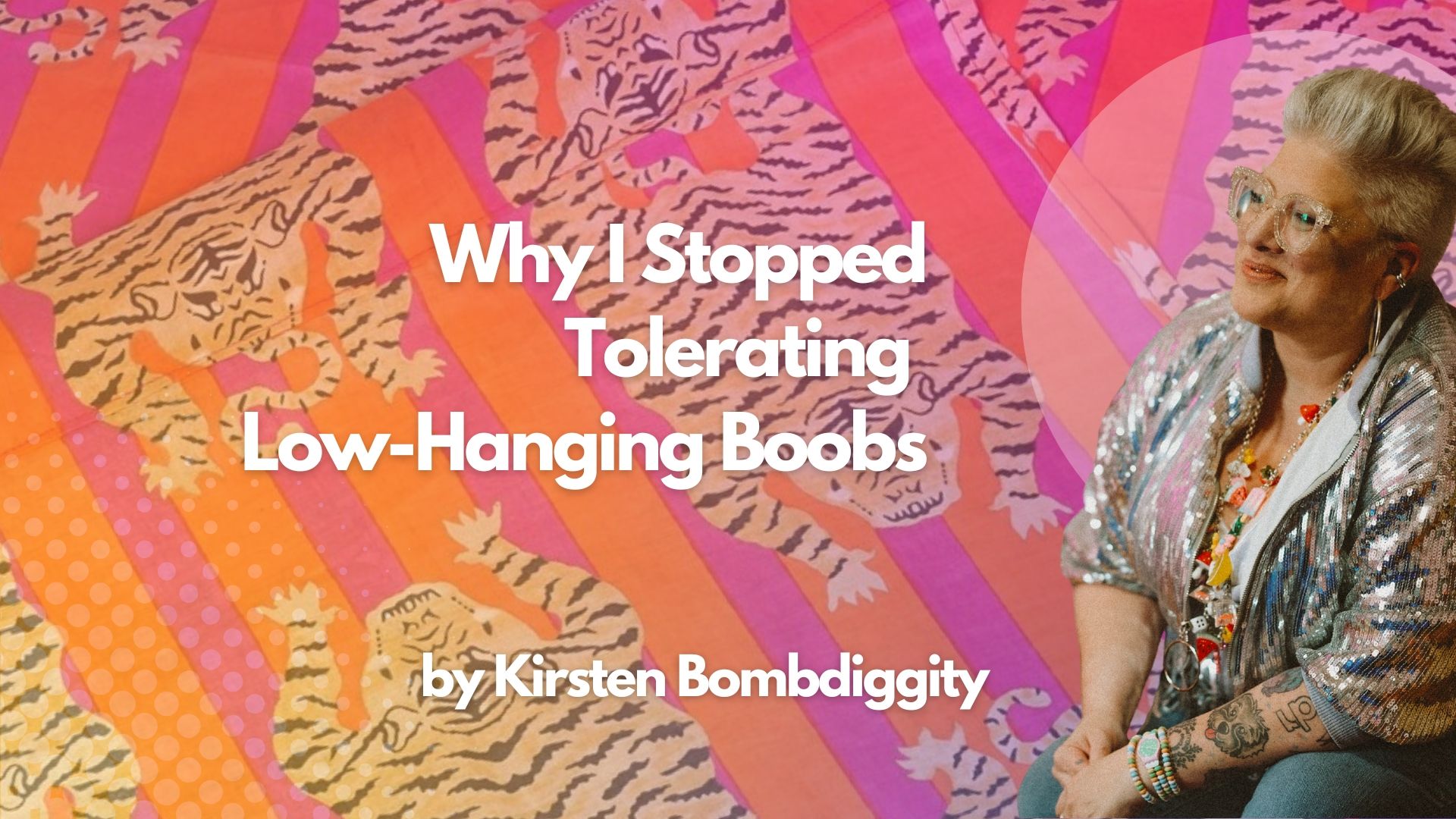
Why I Stopped Tolerating Low-Hanging Boobs
When I bought my house, I bought a shower curtain.
Covered in beautiful boobs.
Which I loved.
Full dopamine decor moment.
But the material itself was cheap and shiny.
I hated it immediately.
And functionally? Annoying AF.
It was hanging on the original rod that came with the house.
Set at a standard, underwhelming six feet.
The same six feet as the shower head.
Which meant every time I turned the water on, a fine mist drifted out and turned my bathroom into a beige, low-budget rainforest.
Again. Not a crisis.
Just enough.
High-achieving women do not fall apart because of big, obvious problems.
We tolerate.
We tolerate things that are slightly off. Slightly annoying. Slightly misaligned.
A chair that isn’t quite comfortable.
A workflow that makes no sense.
A relationship dynamic that drains more than it gives.
A shower curtain that doesn't quite live up to its expectations.
We tell ourselves it’s not a big deal.
But our brains do not categorize things as big deal or not a big deal.
Our brains categorize things as:
Is this aligned
or is this friction
And they keep score.
Check out this science:
Our brains are constantly scanning our environment for patterns.
They are looking for coherence.
They are trying to reduce cognitive load.
When something is off, even slightly, our brains do not ignore it.
They flag it.
Every time we see that thing, a tiny loop runs:
This is not right.
We don’t consciously think it every time.
But our nervous systems register it.
That is micro stress.
Not the kind that sends us into a spiral.
The kind that hums in the background all day like a refrigerator we cannot unplug.
Now stack that.
Dozens of “it’ll do” decisions across our lives.
Our homes. Our schedules. Our boundaries. Our systems.
We are not living in chaos.
We are living in low-grade misalignment.
And our brains are doing extra work every minute to compensate for it.
Then we wonder why we feel tired.
The problem is not the curtain.
The problem is what our brains do with “it’ll do.”
Because every time we live with something we have already decided is not right, we are collecting evidence.
Not about the object.
About us.
Evidence that says:
We notice misalignment and we leave it.
We can see what we want and we do not choose it.
We adjust instead of decide.
Our brains love evidence.
They use repetition to build identity.
So now this is not about taste.
This is about pattern reinforcement.
I bought a new shower curtain.
Bright pink and orange striped tiger fabric.
Not because I needed one.
I already had one.
A perfectly functional, completely fine, already-installed shower curtain.
Buying another one meant:
ordering something new
having my son move the rod
patching and painting the wall
changing something that was technically working
It also meant going taller.
From six feet to eight.
Because the current one lets the shower mist drift out and lightly baptize the rest of the bathroom.
Again. Not a crisis.
Just enough.
But I could already feel it.
What it would be like to walk in, even half asleep in the middle of the night, and not have my brain snag on something that feels off.
Not visually. Not physically. Not functionally.
Just… clean.
Coherent.
Done.
I'm not out here blaming burnout on a shower curtain.
But burnout is often the accumulation of toleration.
Not just in our jobs.
In our environments. In our habits. In our standards.
In every place we have quietly decided, this is good enough, when our bodies already know it is not.
Our brains do not care about our intentions.
They care about our environment.
They care about the signals we are surrounded by.
They care about whether the world we move through feels coherent.
I hit “place order.”
Not because of a curtain.
Because I was done collecting that particular piece of evidence.
We do not need to overhaul our lives.
We do not need reinvention.
We need to stop living with things we have already decided are not right.
Start there.
Our brains will notice.
And they will remember.

