
Who Drives Your Bus?
Children understand consequences.
Long before they understand misogyny, racism, homophobia, ableism, neurodivergence, religion, class, or complicated family systems...
...they're already learning the rules.
Who gets laughed at.
Who gets corrected.
Who gets ignored.
Who gets praised.
Who gets loved more easily.
Children become masters at predicting consequences.
A child growing up with an unpredictable parent becomes hypervigilant.
A queer child learns which parts of themselves feel safest to reveal.
A gifted child discovers achievement earns attention.
Different environments.
A Black child learns that being perceived as angry carries consequences other children never have to think about.
A family peacemaker becomes exquisitely attuned to everyone else's emotions.
An autistic child begins masking.
Same assignment.
Stay connected.
Stay safe.
Stay alive.
The adaptations often work.
Until they don't.
The people-pleaser becomes exhausted.
The perfectionist can't start.
The funny one doesn't know how to ask for help.
The hyper-independent one can't receive love without feeling indebted.
The high achiever keeps collecting accomplishments while quietly wondering why none of them feel like home.
The mask that once opened doors slowly becomes a room with no windows.
Eventually you're no longer wearing it.
You're living inside it.
By midlife, something starts happening.
The strategies that protected us start costing us.
For the first time, the nervous system has enough safety to ask a different question.
Do I still need this?
Sometimes the answer is yes.
Sometimes it's Not anymore.
That's the moment so many women mistake for falling apart.
I wonder if it's actually the beginning of coming home.
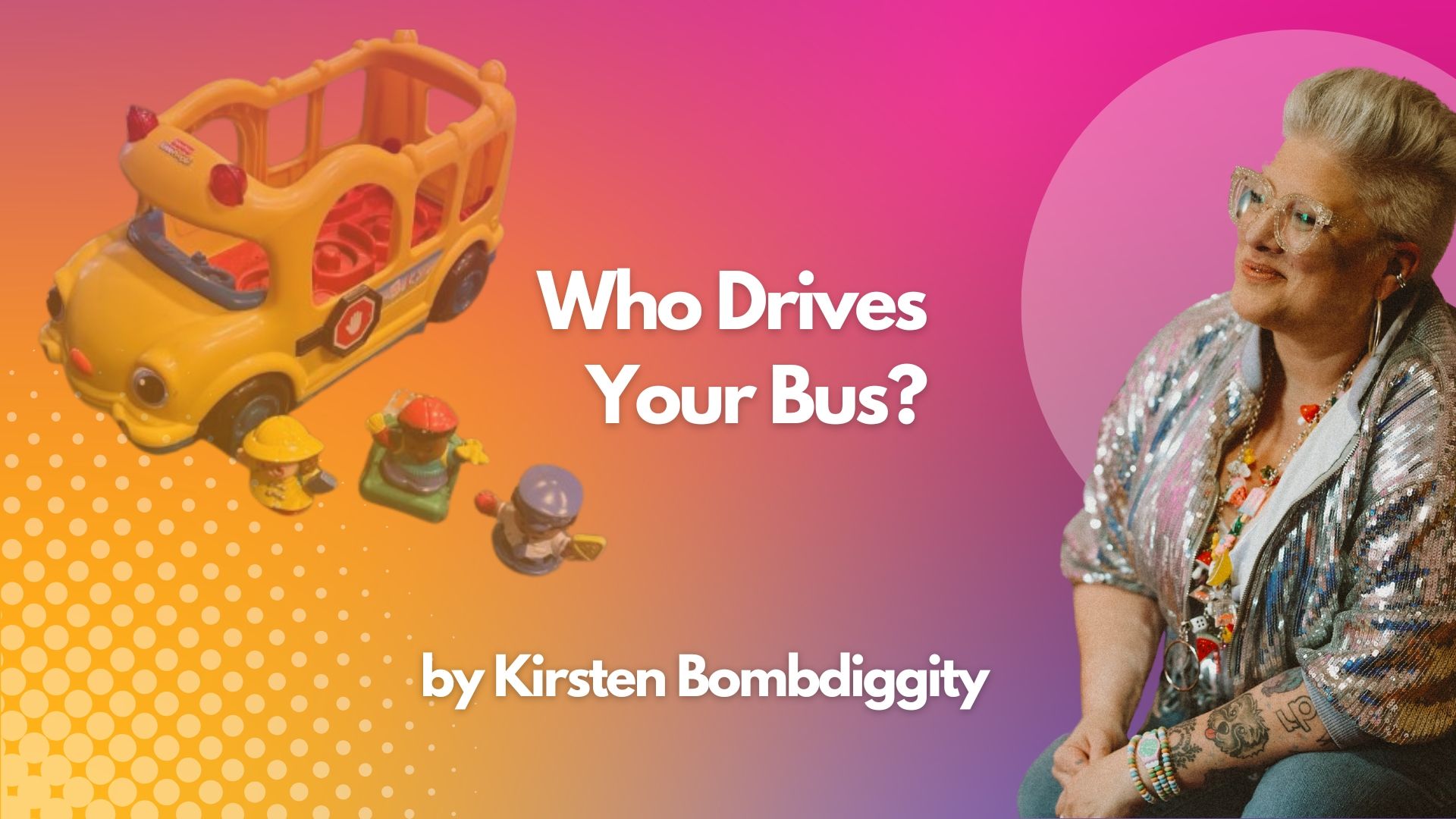
In some of my talks and coaching sessions, I bring out a little Fisher-Price bus.
It fits in the palm of my hand.
The little people bounce in their seats when I roll the wheels.
It's simple on purpose.
Each seat represents a version of us.
The quiet one.
The achiever.
The peacekeeper.
The caretaker.
The one who learned to stay useful.
The one who became capable because it felt safer than needing anyone.
They all belong on the bus.
Every one of them helped get us here.
But every now and then...
...something feels off.
I apologize too fast.
I over-explain.
I shrink.
And sure enough, I look up...
...and there's an older version of me behind the wheel.
Hands firmly at 10 and 2.
I see some of the women I work with carry shame whenever their buses change drivers.
We spend so much energy trying to outgrow them.
Silence them.
Banish them.
What if growing up isn't realizing we hate our bus driver...
...but recognizing she was the driver we needed at the time.
Maybe she isn't waiting to be fired.
Maybe she's been waiting to be relieved.
Maybe that's what coming home looks like.
Climbing back into the driver's seat.
Looking back at every version of me sitting in the seats behind me.
Nodding with gratitude and saying,
"Thank you for getting us here.
I've got this.
You can rest now."

