
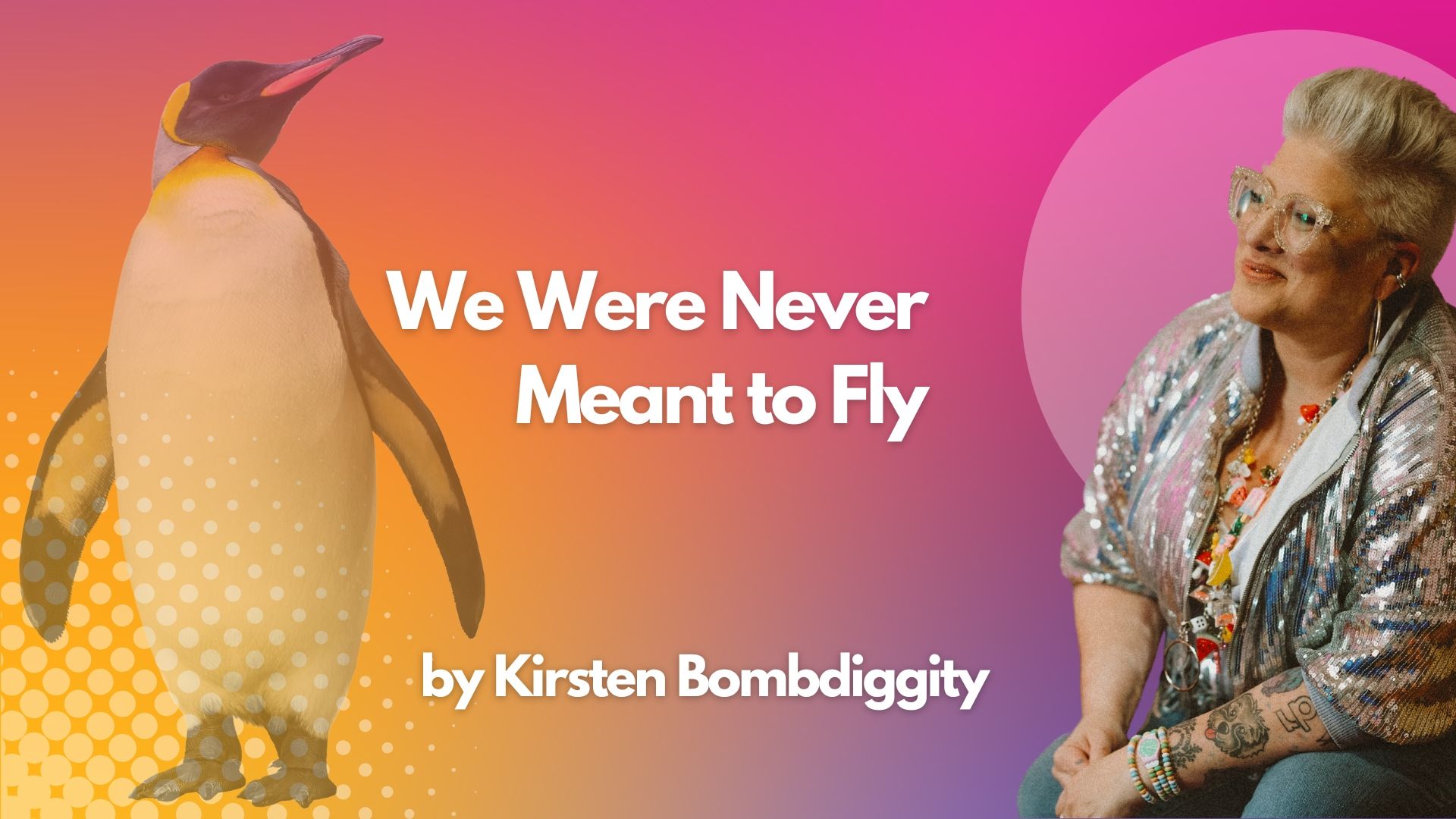
We Were Never Meant to Fly
We love an “up” narrative.
Moving up.
Climbing up.
Rising up.
Showing up.
If it’s not vertical, it doesn’t count.
Which is awkward.
Because lately, vertical feels fake AF.
I’ve spent a shocking amount of my life chasing altitude.
Level up.
Step up.
Lean in.
Push through.
Reach higher.
Everything was skyward.
Everything was air.
And somewhere along the way, I started noticing something uncomfortable.
Flapping harder was not making me freer.
It was making me tired.
I heard this theory that our brains are basically penguins.
Not eagles.
Not hawks.
Not sleek, soaring metaphors of dominance.
Penguins.
Short.
Stubborn.
Social.
Flightless.
They waddle.
They assess.
They hesitate at the edge of the ice and wait for the right moment to dive.
They do not leap into the sky on command.
They do not perform altitude for applause.
They conserve energy.
They huddle.
They survive.
And in water? They are lethal.
We have been told that growth looks like lift.
Higher titles.
Higher standards.
Higher expectations.
If we are not ascending, we must be regressing.
But our biology does not care about branding.
When our inner voice sharpens, our amygdala lights up.
Cortisol rises.
Blood flow shifts away from the prefrontal cortex.
Focus dims.
Planning stalls.
Initiation freezes.
We call it laziness.
Our nervous systems call it threat.
And if we keep yelling? The penguin takes her ball and goes home.
Midlife makes this louder.
Estrogen modulates dopamine.
Dopamine drives initiation and motivation.
When estrogen shifts, dopamine regulation shifts.
The woman who once juggled twelve plates without blinking now stares at a blank screen like schedule her a 5am flight.
We think we’ve lost our edge.
Maybe we’ve just lost tolerance for self-hostility.
Maybe our bodies are done cooperating with altitude at all costs.
Here’s what I see every week in this work:
Women who think they are broken.
Women who believe the solution is more discipline, more hacks, tighter timelines.
And then something small shifts.
Instead of: We have to finish this.
It becomes: Let’s try three minutes.
Instead of: What is wrong with us.
It becomes: I’ve got us. We’ll go slow.
The shoulders drop.
The breath returns.
The task begins.
Not because we flapped harder.
Because we felt safe enough to dive.
Safety unlocks capacity.
Pressure activates survival.
Penguins do not respond to yelling.
They respond to habitat.
Maybe the problem was never ambition.
Maybe it was environment.
Maybe we are not meant to soar endlessly in thin air.
Maybe we are designed for depth.
For rhythm.
For rotation.
For huddling when the wind picks up.
For diving when the water is right.
On land, penguins look awkward.
In water, they are built exactly right.
We are not broken birds.
We are elite swimmers stuck in a productivity pageant.
Midlife is the return to habitat.
We are not meant to flap harder.
We are meant to dive.
Because swimming is flying.
Just in water.

