
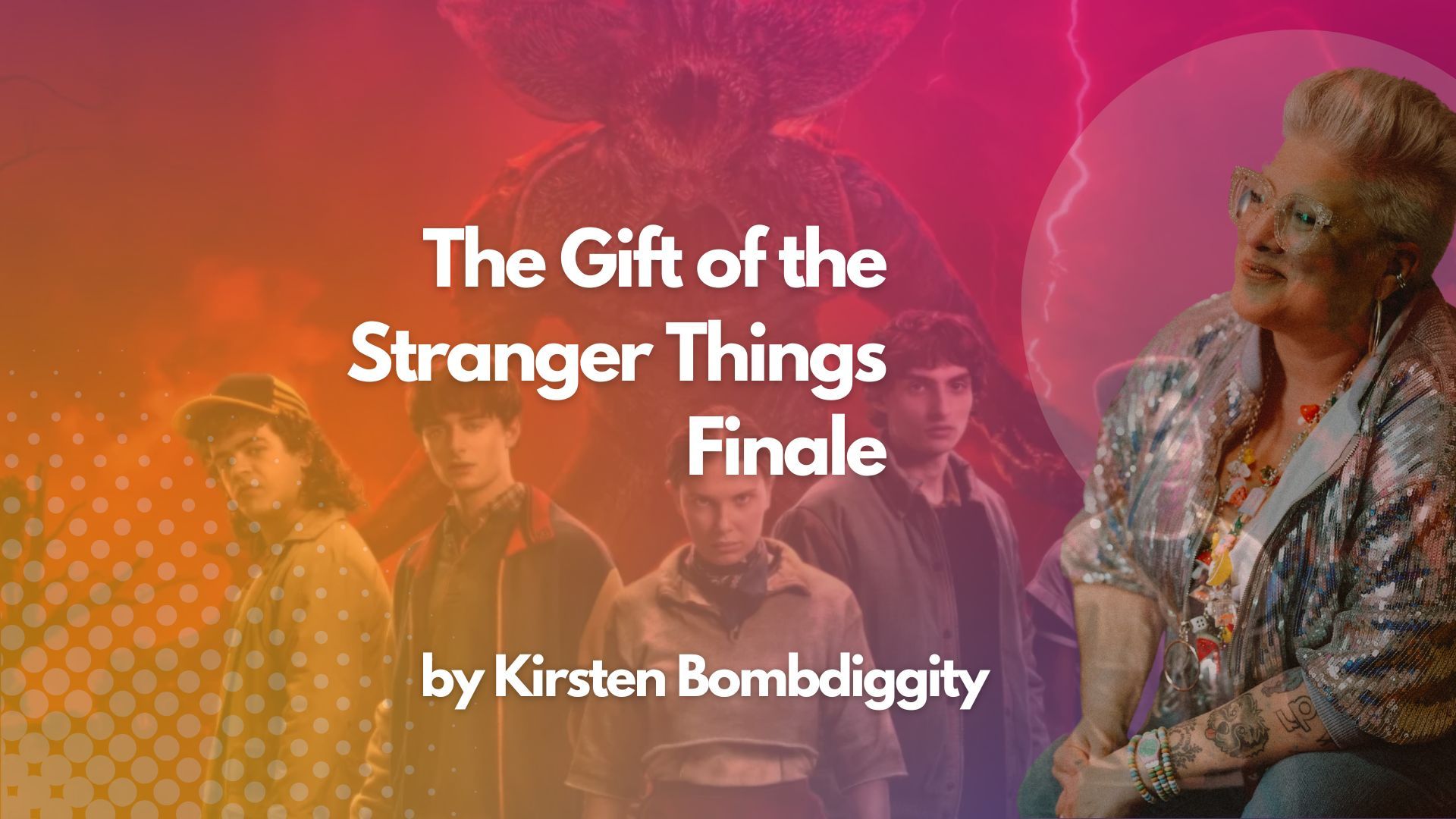
The Gift of the Stranger Things Finale
The big guy in red brought us tickets to see Stranger Things on New Year’s Eve.
Because the Stranger Things finale didn’t just stream. It sold out movie theaters.
Netflix screened the final episode in around 600 theaters over New Year’s Eve and New Year’s Day. No ticket sales. No platform flex. No ownership theatrics.
Instead, they sold concession vouchers.
Theaters made up to $30 million in popcorn, soda, candy, and pure cinematic joy.
On paper, this looks like a weird business workaround. In reality, it was a masterclass in human behavior.
Because Netflix didn’t monetize attention.
They engineered emotion.
THIS WASN'T NOSTALGIA. IT WAS NEUROBIOLOGY.
If you watched the finale in a theater, you already know: It hit different.
Louder laughs. Sharper gasps. Collective silence. The kind that makes your brain go, "Heckyeah, baby!"
That’s not sentimentality. That’s science.
Emotion works because the brain is a horny little meaning machine.
Our brains are constantly asking one question: "Should I remember this?"
Netflix stacked the deck for 100% YES.
WHY OUR BRAINS TAGGED THIS AS "IMPORTANT"
NOVELTY: Watching a TV show in a movie theater violates expectation. Our brains love that. Novelty spikes dopamine, which says: Pay attention.
ANTICIPATION This wasn’t a casual Tuesday-night binge. It was time-bound. Scarce. A moment we had to choose. Anticipation amplifies reward. Always.
FELLOWSHIP We are social mammals. Shared laughter, shock, and silence activate oxytocin — the bonding chemical.
Our nervous systems registered safety and belonging at the same time.
SCALE Big sound. Big image. Big reactions.
A giant screen tells our brains: This is bigger than you.
Humans have always used scale to signal importance — cathedrals, stadiums, bonfires, drums in the dark.
Scale isn’t about spectacle. It’s about significance.
RITUAL This was a finale. An ending. A marker in time.
Ritual tells the brain: This closes a chapter.
Memory formation skyrockets during ritualized experiences.
So no — this wasn’t “just content.”
It was a neurochemical event.
WE DIDN'T JUST WATCH A SHOW. WE WATCHED PEOPLE GROW.
Many of us cried.
Not because the episode was sad — but because we’d spent years with these humans.
We watched them grow up. We watched their voices change. We watched their bodies stretch into adulthood.
And we did it alongside our own lives changing in parallel.
That’s attachment.
Our brains don’t experience long-running characters as fiction. They code them as familiar humans.
Add fellowship — real, breathing people reacting beside us — and the emotional signal multiplies.
Those tears weren’t weakness. They were recognition.
This wasn’t a finale. It was a farewell.
And that’s why the giant screen mattered.
A living room can hold information. A theater can hold collective goodbye.
THE $30 MILLION LESSON HOLLYWOOD NEEDED TO LEARN
Hollywood optimizes for:
-
Control
-
Windowing
-
Ownership
-
Platforms over partnerships
Netflix did the opposite.
They didn’t extract value. They distributed it.
Theaters weren’t competitors. They were amplifiers.
Netflix avoided cannibalizing subscriptions. Theaters got packed houses and sold-out concessions. We got an experience worth leaving the couch for.
Everybody won. Which is exactly why this move is so threatening.
Because it exposes a lie we’re deeply attached to: convenience is the highest value.
It isn’t. Meaning is.
WHY THIS MATTERS MORE THAN MOVIES
Information doesn’t change us. Experiences do.
Two people can receive the same content, the same advice, the same tools — and walk away completely differently.
The difference isn’t intelligence.
It’s whether the experience reached the nervous system.
If our brains don’t tag something as meaningful, it doesn’t stick. It doesn’t integrate. It doesn’t change behavior.
Netflix understood that.
Most industries are still optimizing click-through rates.
WHY IT FELT LIKE A GIFT
We didn’t watch the finale alone on a couch.
We watched it with fellowship and a giant fucking screen.
This was a Christmas present — not because we couldn’t watch it at home, but because this mattered.
We dressed. We showed up. We sat with strangers who cared as much as we did. We laughed together. Flinched together. Held our breath together.
Our brains didn’t log that as entertainment.
They logged it as memory.
THE REAL LESSON NETFLIX TAUGHT US
We don’t gather for content.
We gather for:
-
Meaning
-
Emotion
-
Shared moments
-
Experiences that mark time
Netflix didn’t save movie theaters. They didn’t disrupt them either.
They remembered what they’re for.
And in doing so, they reminded us of something bigger:
When we stop optimizing for attention and start designing for meaning,
humans show up — wallets, hearts, tears, and nervous systems included.

