
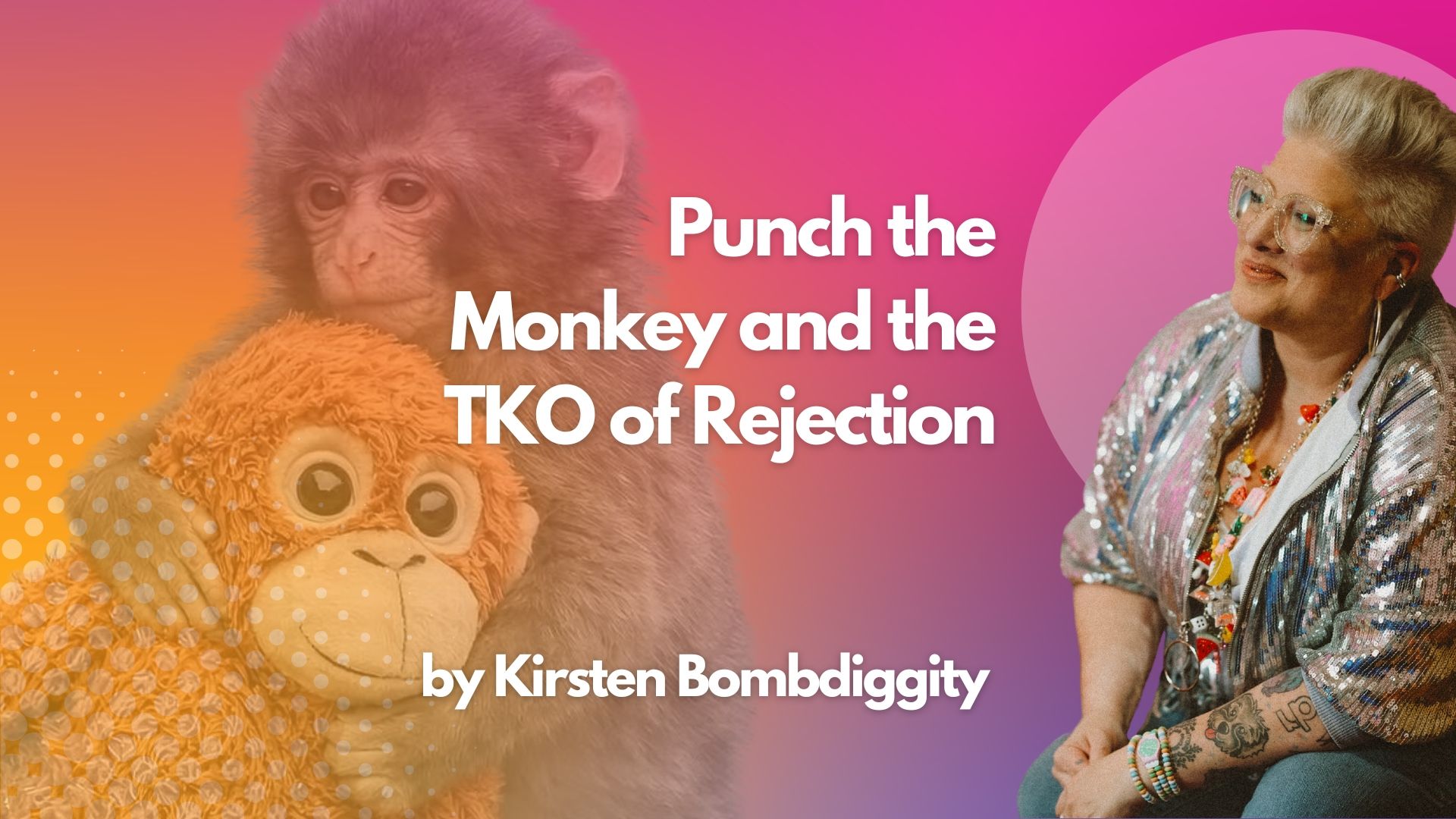
Punch the Monkey and the TKO of Rejection
If you have not been emotionally invested in the social life of a small Japanese macaque named Punch, what are you doing?
Punch is a young monkey at a zoo in Japan who was rejected by his mother and later bullied by his troop.
And for the last couple of weeks, I’ve been checking for Punch updates like a mom on a playground bench fully prepared to throw hands with a ten-year-old bully.
Because he wasn’t just alone. He was being bullied.
And before that?
He’d been rejected by his momma.
Hell nah.
You do not get disowned at home and then targeted in public and expect me to scroll past that like it’s neutral information.
Because one of the quiet purposes of my life is being a safe place for queer young adults whose parents disowned them.
- Helping set up doctor appointments.
- Ordering a pizza to their apartment because I live across the country and warm cheese is the closest thing to a hug.
- Translating insurance forms.
- Rewriting résumés and sitting at a Starbucks practicing interview questions.
- Explaining credit scores.
Logistics love.
When homes fracture, someone has to step in.
And when I learned about Punch?
Big ol’ banana bunch of protective rage.
Attachment wound plus social targeting was a double hit.
We like to pretend social pain is dramatic. It isn’t. The brain processes rejection in the same circuitry as physical injury. The anterior cingulate cortex lights up either way. Threat is threat.
Punch clung to a stuffed animal because he had no one else.
When there isn’t another body to steady us, we find a way to regulate.
Most of us have had our own version of a stuffed animal:
- Overworking.
- Perfectionism.
- Hyper-independence.
- Being the strong one who never needs help.
Those weren’t character flaws.
They were adaptive responses to relational strain.
And on some level, we are Punch.
We've sat inside rooms where we technically belonged and still felt targeted.
For being sensitive.
For being ambitious.
For being queer.
For being different.
We learned to survive it.
Be pleasant. Be impressive. Be useful. Be easy. Be the adult.
Belonging became something we earned.
Midlife recalibrates the equation.
Hormones shift. Estrogen stops buffering stress the way it once did. Cortisol tolerance changes. Dopamine regulation moves.
Translation: what we powered through at 35 now feels abrasive at 47.
We are less willing to tolerate chronic targeting.
We are less willing to audition for proximity.
When Go-chan walked up and sat next to Punch, he didn’t fix him.
He didn’t dominate him.
He didn’t rescue him.
He sat close.
That’s it.
And something in us unclenched.
We are Go-chan too.
We have walked toward someone else who survived their own circus and closed the distance.
We have texted first. Stayed late. Carried more than our share.
Some seasons, we need someone to sit with us. In others, we stand watch.
There is also an adult monkey who protects Punch now. He is no longer the only one guarding his own perimeter.
Some of us learned early that if we didn’t guard ourselves, no one would.
Punch didn’t need dominance. He needed someone to close the distance.
When someone finally did, the fight stopped.
Not because he got stronger. Because he wasn’t alone.
Strength isn’t the opposite of loneliness. Presence is.

