
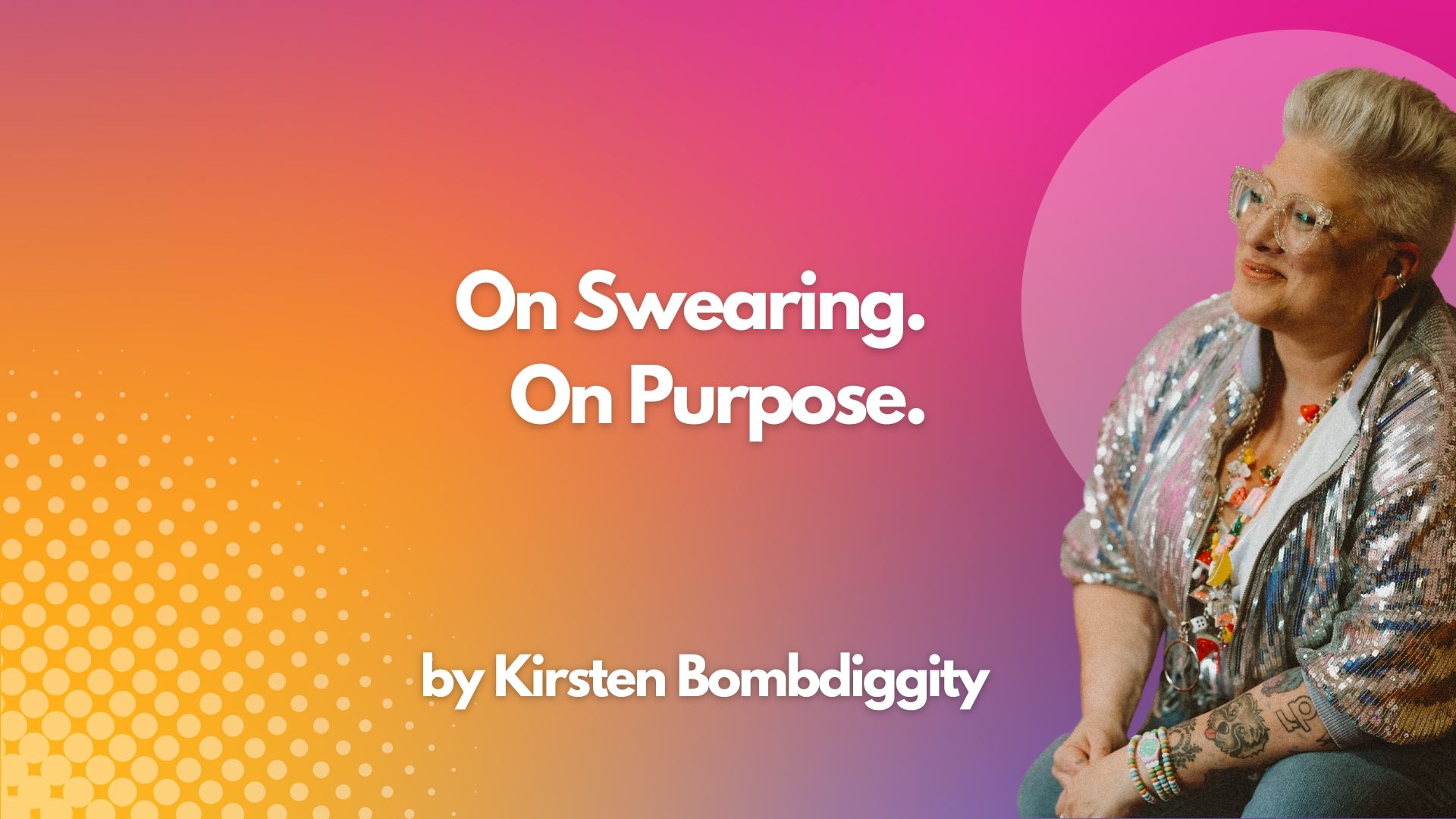
On Swearing. On Purpose.
A lot of us cuss.
Not always.
Not indiscriminately.
Not because we “don’t know other words.”
We cuss because we’ve been alive long enough to understand language as a tool, not a moral referendum.
We’ve moderated ourselves for decades. We’ve translated sharp truths into softer shapes. We’ve watched entire meetings stall out because someone said “let’s circle back” instead of what everyone was actually thinking.
So yes. Sometimes we swear.
Not as rebellion.
As efficiency.
The Myth That Refuses to Die
Somehow, swearing still gets bundled up with:
-
low intelligence
-
lack of discipline
-
emotional volatility
-
unprofessionalism
Which is objectively funny, given how many of us swear while holding advanced degrees, running departments, managing budgets, raising humans, navigating grief, burnout, menopause, and midlife reinvention. Sometimes all before lunch.
The myth survives because it’s convenient.
It lets people confuse tone with competence.
Let’s Add Some Nerd Spice
Swearing is not correlated with weaker language skills. In fact, people who can generate more swear words tend to score higher in overall verbal fluency and vocabulary. (Kristin Jay & Timothy Jay showed this in a 2015 Language Sciences study, which delights me more than it should.)
Translation: swearing isn’t what happens when you run out of words.
It’s what happens when you have range.
There’s also research suggesting that people who swear more frequently tend to be more emotionally honest and, in some contexts, less likely to lie in self-reporting tasks. Swearing reduces social filtering, not cognitive capacity. (Same research thread. Same conclusion.)
Then there’s how our brains respond.
Swear words are processed differently than neutral language. They activate emotional centers of the brain. They increase attention. They stick in memory longer. They’ve even been shown to increase pain tolerance in cold-pressor studies. (Yes, really. Your nervous system treats a swear word like a signal flare.)
There’s a reason “I am mildly displeased” has never once moved a room.
Our brains respond to voltage, not politeness.
There’s even research suggesting that swearing can help people feel more focused and confident, like a micro-boost to help us take action and reduce overthinking (University of Alabama).
And Then There’s Gender
Let’s say this cleanly and leave it alone.
Men swear and it signals authority.
Women swear and it’s labeled trashy.
Same word.
Different judgment.
Research on gendered language norms shows this over and over again: identical speech is evaluated differently depending on who’s delivering it. Directness from men reads as confidence or leadership. The same directness from women is more likely to be read as abrasive, emotional, or unprofessional.
That gap isn’t subtle.
And it isn’t accidental.
Like We Didn’t Notice
Most of us who swear also know exactly when not to.
Around small children.
In certain professional spaces.
When clarity requires restraint instead of emphasis.
We code-switch because we can.
Not because we’re confused.
We don’t swear everywhere.
We swear where it’s honest.
That’s not a lack of control.
That’s mastery.
Faith, Values, and the Pearl-Clutching Spiral
Plenty of us are thoughtful, principled, values-driven women who also swear.
These things coexist just fine.
Language is not the measure of character.
Intent is.
Integrity is.
What we choose to stand for when it actually costs something is.
If a four-letter word causes more alarm than cruelty, dishonesty, or indifference, the issue isn’t vocabulary.
It’s misdirection.
Listen Up, Buttercup
We’re not interested in censoring ourselves to make other people more comfortable.
Not because we’re reckless.
Not because we’re edgy.
Not because we don’t know better.
But because we do.
We know how language works.
We know when the clean word fits.
And we know when it absolutely does not.
If that filters people out, that’s not a flaw.
That’s a sorting mechanism.
If this sounds like you, good.
You already know what you’re doing with language.
And if it doesn’t, that’s fine too.
We’re not taking attendance.

