
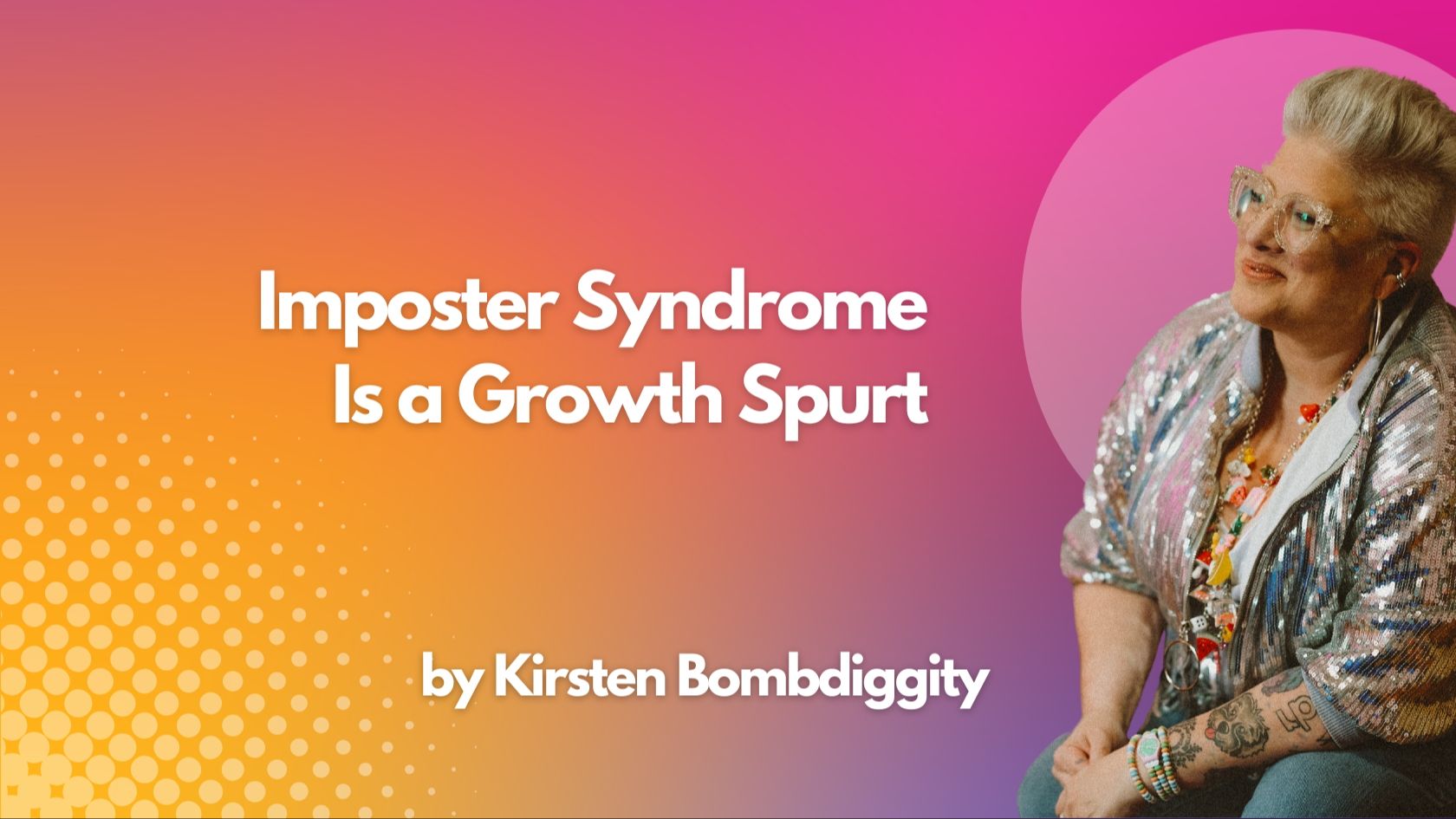
Imposter Syndrome Is a Growth Spurt
What if imposter syndrome isn't a confidence issue?
Or a woman forgetting she’s accomplished?
Or a character flaw?
What if imposter syndrome is a growth spurt?
Because imposter syndrome tends to show up at the exact moment a woman is expanding beyond the identity her nervous system has practiced surviving inside.
That is not pathology.
That is transition.
Which matters because women have spent decades moralizing what are often nervous system experiences.
Judging exhaustion as laziness.
Overstimulated as distracted.
Growth as arrogance.
The body keeps receipts for all of it.
Researchers have found that the brain interprets uncertainty and social evaluation using many of the same neural pathways associated with physical threat.
Basically? Your nervous system doesn't distinguish between the fear of disappointing someone and a tiger eating your face.
To ancient wiring, both can register as risk.
Which explains why so many women hit a new level of visibility, leadership, creativity, honesty, boundaries, joy, or ambition and their inner compliance officer screams:
Denied. Unauthorized. Wrong.
When biologically, something may have gone very right.
Because growth requires recalibration.
The nervous system has to update its internal model of who we are capable of being.
And women over 40 are often doing that recalibration while simultaneously:
working
caretaking
managing households
supporting everyone else emotionally
performing competence
pretending we’re “fine”
and continuing to function at levels that would have decimated earlier versions of ourselves.
We are doing all of this while our hormones are changing in real time.
Estrogen impacts dopamine regulation, mood stability, working memory, and stress response. During perimenopause and menopause, fluctuating estrogen can directly affect confidence, focus, emotional regulation, and cognitive processing speed.
But culturally, women are rarely taught to interpret this compassionately.
We are taught to interpret discomfort as evidence we should shrink.
Screw that.
Women simply don't feel like imposters while playing small.
They feel it while expanding.
Imposter syndrome puffs its chest after competence.
Promotion.
Visibility.
Boundaries.
Dating after divorce.
Identity after caregiving.
Business ownership.
A louder voice.
A refusal to abandon themselves for approval.
That’s when the nervous system activates every old survival pattern it has available.
Not because the woman is incapable.
Because the identity is unfamiliar.
And unfamiliarity is metabolized by the nervous system as potential danger until repetition teaches otherwise.
Neuroplasticity research shows the brain changes through repeated experience, not intellectual understanding alone.
We do not think our way into legitimacy.
We experience our way there.
Repeatedly.
Messily.
Through evidence.
This is why affirmations alone often fall flat.
The nervous system wants proof.
Not performance.
Not slogans.
Not prettier self-talk.
Proof.
It wants:
repetition
safety
evidence
survived experiences
new patterns
embodied confirmation
It wants to learn that we can disappoint others and take up space without causing organ failure.
That is nervous system work.
And for many women over 40, there comes a point where the old identity starts costing more than it protects.
The nervous system eventually sends the overdue invoice.
Not because a woman is broken.
Because she has outgrown the container.
Which is why I think “imposter syndrome” is sometimes the wrong diagnosis entirely.
A lot of women are not secretly underqualified.
They are in the neurological transition between identities.
And transition seasons are disorienting.
Old patterns stop fitting before new ones feel automatic.
Not all fear is intuition.
Sometimes fear is simply unfamiliarity.
Because once we stop interpreting every internal wobble as evidence we’re frauds, we can ask a radically honest question:
What if this is proof that I’m growing faster than my nervous system can keep up with?
At this stage of our lives, we don't care nearly as much about being impressive as we do about being real.
More real.
More alive.
More ourselves.
What if instability is nothing more than the opening act for confidence?
I care deeply about this work because I still remember this terrain in my own body.
The best guides aren't always speaking from a polished happily-ever-after.
They're often the ones who still remember where the trail bends.
A few things worth remembering:
-
The nervous system hates unfamiliarity before it learns from it.
-
Confidence is usually evidence collected after action, not before it.
-
Women are often taught to confuse discomfort with danger.
-
Expansion feels destabilizing because identity is biological, not just intellectual.
-
Imposter syndrome frequently appears right before a new self-concept stabilizes.
-
Growth can feel like grief because old identities are still shedding.
-
Your body may be recalibrating, not betraying you.
-
Sometimes the “fraud” feeling is just your nervous system realizing the old version of you no longer fits.
The work of coming home to ourselves is not light work.
It is nervous system work.
Identity work.
Evidence work.
And sometimes it looks suspiciously like the nervous system screaming “WE’RE DYING” five minutes before a breakthrough.

